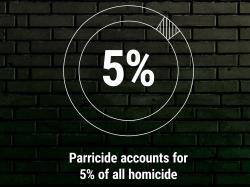
This study examines the characteristics of parricide in Australia using 35 years of data from the National Homicide Monitoring Program.
Parricide, or the homicide of a parent by their child, comprises five percent of homicides each year. Offenders were predominantly male but victimisation was more even. Parricide was largely gendered, with sons more likely to kill their fathers and daughters to kill their mothers. Offenders aged 10–17 years committed parricide at higher rates than older homicide offenders and almost a fifth of parricide offenders were delusional at the time of the homicide.
Findings illustrate the distinctiveness of parricide and the greater need to consider this form of lethal violence in responses to family violence.
References
URLs correct as at May 2025
Australian Broadcasting Corporation 2023. Gold Coast woman Wendy Sleeman’s son, Slade Murdok, charged with her murder. ABC News, 31 January. https://www.abc.net.au/news/2023-01-31/qld-wendy-sleeman-son-slade-murdok-charged-with-murder/101902910
Australian Broadcasting Corporation 2015. Adelaide Crows coach Phil Walsh stabbed to death, son charged with murder. ABC News, 3 July. https://www.abc.net.au/news/2015-07-03/crows-coach-phil-walsh-allegedly-murdered-son-charged/6591832
Australian Bureau of Statistics 2021. Standard for sex, gender, variations of sex characteristics and sexual orientation variables. Canberra: ABS. https://www.abs.gov.au/statistics/standards/standard-sex-gender-variations-sex-characteristics-and-sexual-orientation-variables/2020
Australian Bureau of Statistics 2014. Indigenous status standard, version 1.5. https://www.abs.gov.au/statistics/standards/indigenous-status-standard/2014-version-15
Bojanić L, Flynn S, Gianatsi M, Kapur N, Appleby L & Shaw J 2020. The typology of parricide and the role of mental illness: Data-driven approach. Aggressive Behaviour 46: 516–522. https://doi.org/10.1002/ab.21906
Bourget D, Gagné P & Labelle M-E 2007. Parricide: A comparative study of matricide versus patricide. Journal of the American Academy of Psychiatry and the Law 35: 306–312
Bows H 2019. Domestic homicide of older people (2010–15): A comparative analysis of intimate-partner homicide and parricide cases in the UK. British Journal of Social Work 49(5): 1234–1253. https://doi.org/10.1093/bjsw/bcy108
Boxall H & Sabol B 2021. Adolescent family violence: Findings from a group-based analysis. Journal of Family Violence 36: 787–797. https://doi.org/10.1007/s10896-021-00247-8
Fegadel A & Heide KM 2017. Offspring-perpetrated familicide: Examining family homicides involving parents as victims. International Journal of Offender Therapy and Comparative Criminology 61(1): 6–24. https://doi.org/10.1177/0306624X15589091
Fitz-Gibbon K, Meyer S, Boxall H, Maher J & Roberts S 2022. Adolescent family violence in Australia: A national study of service and support needs for young people who use family violence. Research report 18/2022. Sydney: Australia’s National Research Organisation for Women’s Safety
Heide K 2013. Understanding parricide: When sons and daughters kill parents. New York: Oxford University Press
Heide K 1992. Why kids kill parents: Child abuse and adolescent homicide. Sage Publishing
Heide K & Petee T 2007a. Parricide: An empirical analysis of 24 years of U.S. data. Journal of Interpersonal Violence 22(11): 1382–1399. https://doi.org/10.1177/0886260507305526
Heide K & Petee T 2007b. Weapons used by juveniles and adult offenders in U.S. parricide cases. Journal of Interpersonal Violence 22(1): 1400–1411. https://doi.org/10.1177/0886260507305528
Hillbrand M, Alexandre JW, Young JL & Spitz RT 1999. Parricides: Characteristics of offenders and victims, legal factors, and treatment issues. Aggression and Violent Behavior 4(2): 179–190. https://doi.org/10.1016/S1359-1789(97)00056-6
Holt A 2017. Parricide in England and Wales (1977–2012): An exploration of offenders, victims, incidents and outcomes. Criminology and Criminal Justice 17(5): 568–587. https://doi.org/10.1177/1748895816688332
Marleau JD, Auclair N & Millaud F 2006. Comparison of factors associated with parricide in adults and adolescents. Journal of Family Violence 21: 321–325. https://doi.org/10.1007/s10896-006-9029-z
Menagh J 2021. Teancum Petersen-Crofts faces trial accused of Ellenbrook murders of mother and siblings. ABC News, 12 February. https://www.abc.net.au/news/2021-02-12/teancum-petersen-crofts-on-trial-accused-of-ellenbrook-murders/13147940
Miles C, Condry R & Windsor E 2023. Parricide, mental illness, and parental proximity: The gendered contexts of parricide in England and Wales. Violence Against Women 29(2): 87–111. https://doi.org/10.1177/10778012221077127
Miles H & Bricknell S 2025. Homicide in Australia 2023–24. Statistical Report no. 52. Canberra: Australian Institute of Criminology. https://doi.org/10.52922/sr77826
Myers WC & Vo EJ 2012. Adolescent parricide and psychopathy. International Journal of Offender Therapy and Comparative Criminology 56(5): 715–729. https://doi.org/10.1177/0306624X11410587
Peck A, Hutchinson M & Provost S 2021. Young people who engage in child to parent violence: An integrative review of correlates and developmental pathways. Australian Journal of Psychology 73(4): 405–451. https://doi.org/10.1080/00049530.2021.1936637
Qu L, Kaspiew R, Carson R, De Maio J, Harvey J & Horsfall B 2021. National elder abuse prevalence study: Final report. Melbourne: Australian Institute of Family Studies. https://aifs.gov.au/research/research-reports/national-elder-abuse-prevalence-study-final-report