The awards were held at a ceremony in Parliament House, Canberra. The winners were presented with their awards by Heather Cook, Director of the Australian Institute of Criminology. Read the media release.
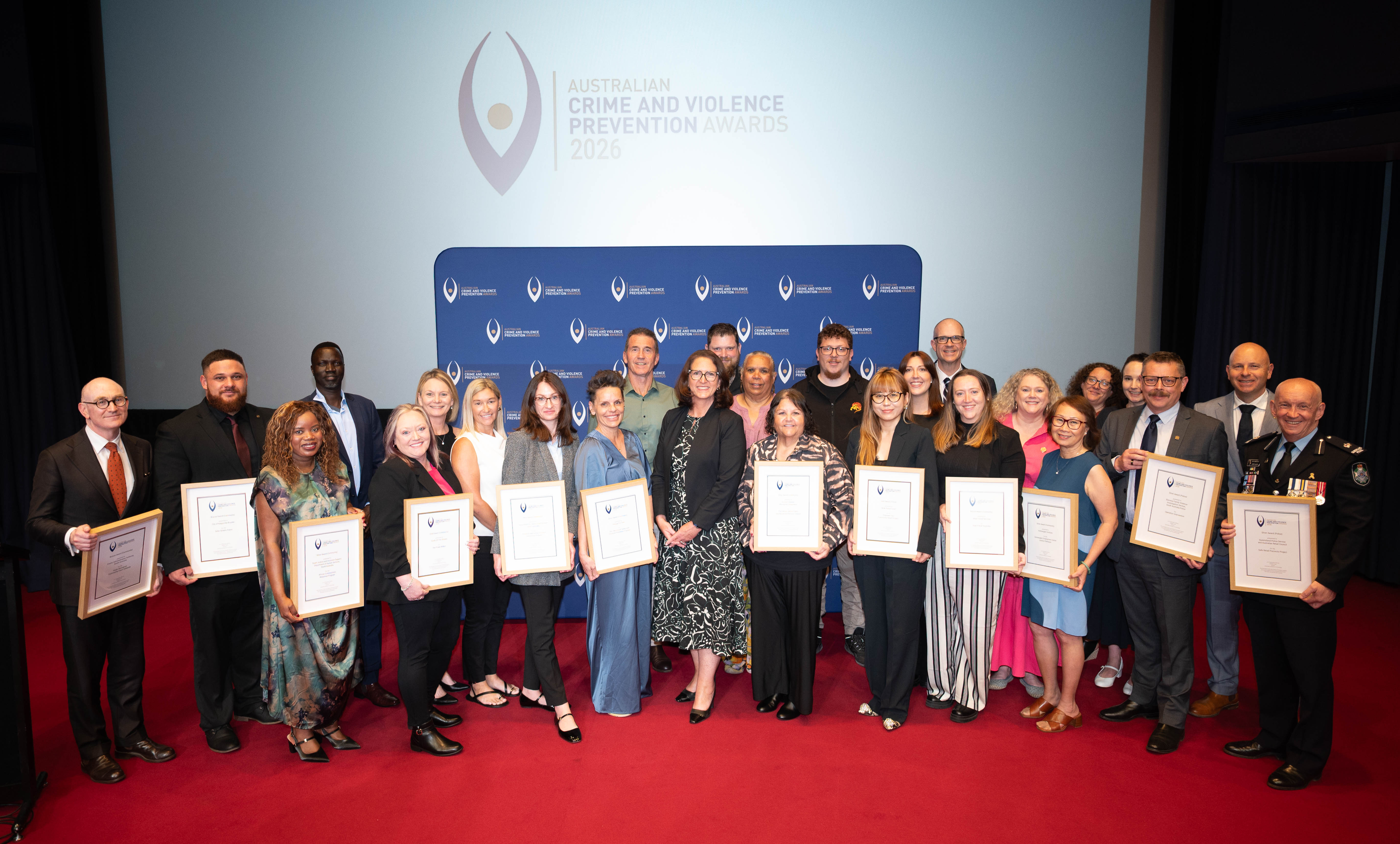
Community-based project winners
Gold award winner
The Power Within — Youth off the Streets
The Power Within is an intensive, Youth Off The Streets (YOTS) school-based program which supports and educates young people who are at risk of experiencing or repeating the cycle of domestic, family and sexual violence (DFSV).
Delivered to students at YOTS’ independent schools, the program creates a safe, trauma-informed environment where young people can learn about respectful relationships and DFSV. Many of the students have limited exposure to healthy family and intimate relationships, therefore our project teaches them how to recognise and respond to abuse, whilst supporting them to move forward with their lives and break the cycle of violence.
Silver award winners
The Yallum Yallum Elders and Respected Persons Council — Goolum Goolum Aboriginal Cooperative
The Yallum Yallum Elders and Respected Persons Council was created to divert Aboriginal people from the criminal justice system. The Council provides oversight and guidance to participants on their journey towards cultural healing, social and emotional wellbeing and a stronger role in culture and community.
The Elders say “our approach is centred around the participant’s journey to mend harm caused and further develop their identity as an Aboriginal community member. Through open conversation we encourage participants to grow, and strengthen their community and cultural connections, rather than allowing shame to create distance between them and their community”.
Holmesglen Employment Centre Justice Pathways — Holmesglen Institute
Holmesglen Employment Centre Justice Pathways is a coordinated education and employment support model built within a TAFE and operating across Melbourne’s south-east. Launched in early 2023, the program triages justice-involved individuals across multiple government-funded services including Reconnect, Skills and Jobs Centre, Victorian Early Leaver Connection Initiative, Vocational Major, and Apprentice Central delivering what clients experience as a single, seamless service.
Formalised through a Memorandum of Understanding with the Department of Justice, the program has supported 274 referrals, with 83 participants achieving a tangible education or employment outcome, a conversion rate that reflects the complexity of the cohort and the effectiveness of the model.
African Communities Response Program — Youth Justice and Inclusion Support, Department of Human Services, South Australia
The African Communities Response program is a culturally responsive early intervention initiative delivered by the Department of Human Services in partnership with the Attorney-General’s Department. Drawing on the cultural expertise and trusted relationships of African Cultural Background practitioners, ACR provides tailored case management for young people aged 10–18 involved in, or at risk of, street gang-related offending and disengagement.
Through brokerage funding and culturally informed supports, the program strengthens engagement with education, employment, family supports, mentoring, and community connection to reduce offending and prevent deeper involvement in the justice system.
Domestic and Family Violence Intervention Program — Department for Correctional Services South Australia
The Domestic and Family Violence Intervention Program (DFVIP) is a 20 week, 120-hour, group-based offender rehabilitation program for men with a history of domestic violence offending who are under Department for Correctional Services supervision.
Delivered in custodial and community settings since October 2020, the program aims to reduce domestic and family violence, improve victim safety, and disrupt entrenched patterns of abuse.
24/7 Monitored Safety and Violence Prevention Program — Change For Sam
Change For Sam delivers a targeted, real-time violence prevention intervention by providing 24/7 monitored personal safety devices to victim-survivors of family violence at high risk of harm. Devices are supplied at no cost to trusted partner agencies, who distribute them safely to those most at risk. The devices enable immediate emergency response, GPS tracking, and direct connection to a 24/7 monitoring service.
Importantly, device recordings are court-admissible, supporting stronger legal accountability. By addressing a critical gap in access to immediate, monitored safety options, the program actively prevents violence and supports victim-survivors to live more safely and independently.
Bronze award winners
Stop It Now! Australia — Jesuit Social Services
Stop It Now! Australia is a child sexual abuse prevention program that offers an anonymous helpline and online resources (including self-help modules) for people concerned about their own or someone else’s sexual thoughts and behaviours towards children.
The program works with individuals to build understanding and awareness of risk, build motivation to facilitate change and identify and implement actions associated with reducing risk factors and increasing protective factors to prevent the occurrence or reoccurrence of child sexual abuse.
Safer Streets Patrol — City of Kalgoorlie-Boulder
The City of Kalgoorlie-Boulder’s Safer Streets Patrol (SSP) is a proactive, community-led, grassroots crime and violence prevention initiative that improves safety while supporting vulnerable members of the community, particularly First Nations people visiting from remote communities. Operating through strong community partnerships and respectful, culturally appropriate engagement, SSP helps prevent high-risk behaviour from escalating into harm, policing or justice involvement.
Significantly expanded since its inception, SSP’s preventive, early intervention, relationship-based model improves both actual and perceived safety in public spaces and demonstrates a locally tailored approach that has strong potential for adaptation across Australia.
Youth Aboriginal Community Court Adelaide — Courts Administration Authority South Australia
The Youth Aboriginal Community Court Adelaide (YACCA) is a specialist therapeutic court for Aboriginal and/or Torres Strait Islander young people. As part of YACCA the young person’s sentence is delayed while they participate with an external service provider agency to address factors that have contributed to their offending behaviour.
The young person returns to YACCA at short intervals (determined by need), and their progress and engagement with the service provider agency is monitored. The YACCA includes Aboriginal Elders and Respected Persons in the court process and by doing so provides YACCA proceedings with a cultural authority.
Police-led project winners
Gold award winner
Empower You Community Reach Project — NSW Police Force
The Empower You Community Reach project is a tailored domestic violence prevention initiative for multicultural communities, addressing gaps in generic messaging that often overlooks cultural and language needs. It raises awareness of DV and improves access to support for groups facing barriers to help-seeking.
Using social and situational crime prevention approaches, the project partners with places of worship, schools and businesses to display bilingual signage with QR codes linked to a police-developed app, demonstrating collective community leadership against DV. A joint police and community leader video, translated into 11 languages and hosted on the NSW Police public website, further expands reach and accessibility.
Silver award winners
Safe Retail Precincts Project — Queensland Police Service and Australian Retail Council
The Safe Retail Precincts project delivered an innovative, harm‑focused approach to retail safety, harm and crime by building strong, precinct‑based partnerships between police, retailers, centre management, and industry bodies. It shifted beyond traditional enforcement models by empowering frontline retail workers as prevention and intelligence partners and using shared data to target high‑harm behaviour, locations, and times.
The collaborative framework improved trust, reporting quality, and coordinated responses, delivering measurable reductions in risk and harm. Designed as a scalable and repeatable model, the project provides a proven blueprint that can be sustainably expanded across retail precincts to strengthen public safety and community confidence.
Operation Intervention — Barossa Family Violence Investigation Section, South Australia Police
Operation Intervention is a crime prevention initiative led by the SAPOL Gawler/Barossa Family Violence Unit in partnership with OARS Community Transitions (OARS CT). The project creates a direct referral pathway from law enforcement to specialist perpetrator intervention, with SAPOL identifying individuals who have come to attention for domestic, family, and sexual violence and referring them to OARS CT for structured assessment and evidence-based program participation.
By engaging perpetrators early – before harm escalates or justice system involvement becomes unavoidable – the model interrupts the cycle of DFSV at its source, reflecting a shared commitment to perpetrator accountability and victim-survivor safety.
Small Steps 4 Hannah — Tasmania Police
Small Steps 4 Hannah is a training initiative focused on improving responses to family violence by strengthening understanding of coercive control and reducing the misidentification of victim-survivors. Delivered in partnership with Tasmania Police, the Department of Justice and the Small Steps 4 Hannah Foundation, the program uses Hannah Clarke’s story to help participants identify primary aggressors and early warning signs often missed in incident-based policing.
The workshops have been delivered to nearly all members of Tasmania police and across government and non-government sectors, reaching thousands of participants and driving immediate, practice-level change that improves collaboration, accountability and outcomes for victim-survivors.